



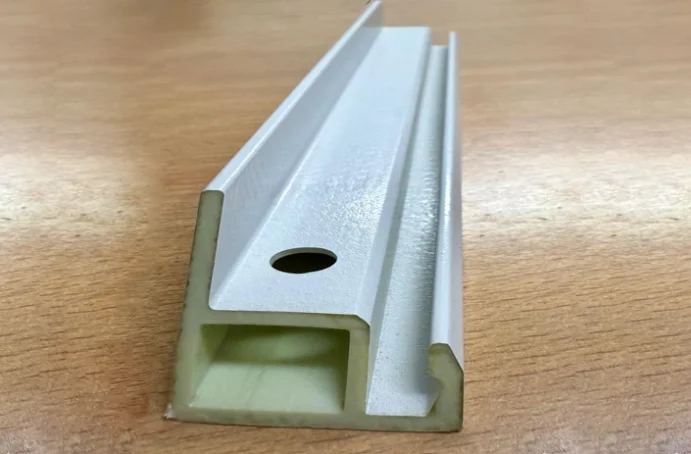
Lightweight, corrosion-proof frames for next-gen PV modules
Our polyurethane (PU) pultruded solar frames combine low weight, high mechanical strength, and exceptional weatherability—ideal for rooftop, utility, coastal and high-temperature installations. Non-metallic construction improves electrical insulation and mitigates PID, while pultrusion enables precise, repeatable profiles at scale.
Where It Excels

Coastal & Humid Climates
Salt-spray/UV resistance

High-Temperature Regions
Thermal expansion better matched to glass

Large-scale Utility & Rooftop Projects
Lighter frames, faster installs

PID-sensitive sites
Non-conductive frames reduce leakage pathways
Technical Overview
- Process: Continuous fibers are impregnated with reactive PU resin and pulled through a heated die to form rigid, high-precision profiles—ideal for long, straight frame members with tight tolerances.
- Core properties: High specific stiffness/strength, dimensional stability, excellent surface durability, and superior electrical insulation compared with metals.
Why PU Composite Over Aluminum?
| Feature | PU Composite Frame | Aluminum Frame |
|---|---|---|
| Carbon footprint | ~85% lower cradle-to-gate emissions vs. aluminum. | High energy intensity in primary production. |
| Weight | ~20% lighter; easier handling & logistics. | Heavier; higher handling effort. |
| Mechanical strength | Very high; reported up to 6× tensile strength vs. aluminum in composite PU systems. | Good, but lower specific strength. |
| Corrosion/weather resistance | Excellent (UV, humidity, salt-spray, acids/alkalis). | Good (anodized), can corrode in harsh/coastal sites. |
| Electrical behavior / PID | Non-metallic insulator → PID mitigation; no grounding needed. | Conductive; grounding required; higher PID risk. |
| Thermal compatibility with glass | CTE closer to glass; less thermal stress/micro-cracks in hot climates. | Higher CTE; greater stress under temperature swings. |
| Cost | ~20–25% lower material cost (current market reports). | Typically higher. |
| Design flexibility | Pultrusion enables custom profiles, ribs, channels, co-molded features. | Mostly standard extrusions. |
(CTE = coefficient of thermal expansion; PID = Potential-Induced Degradation)