


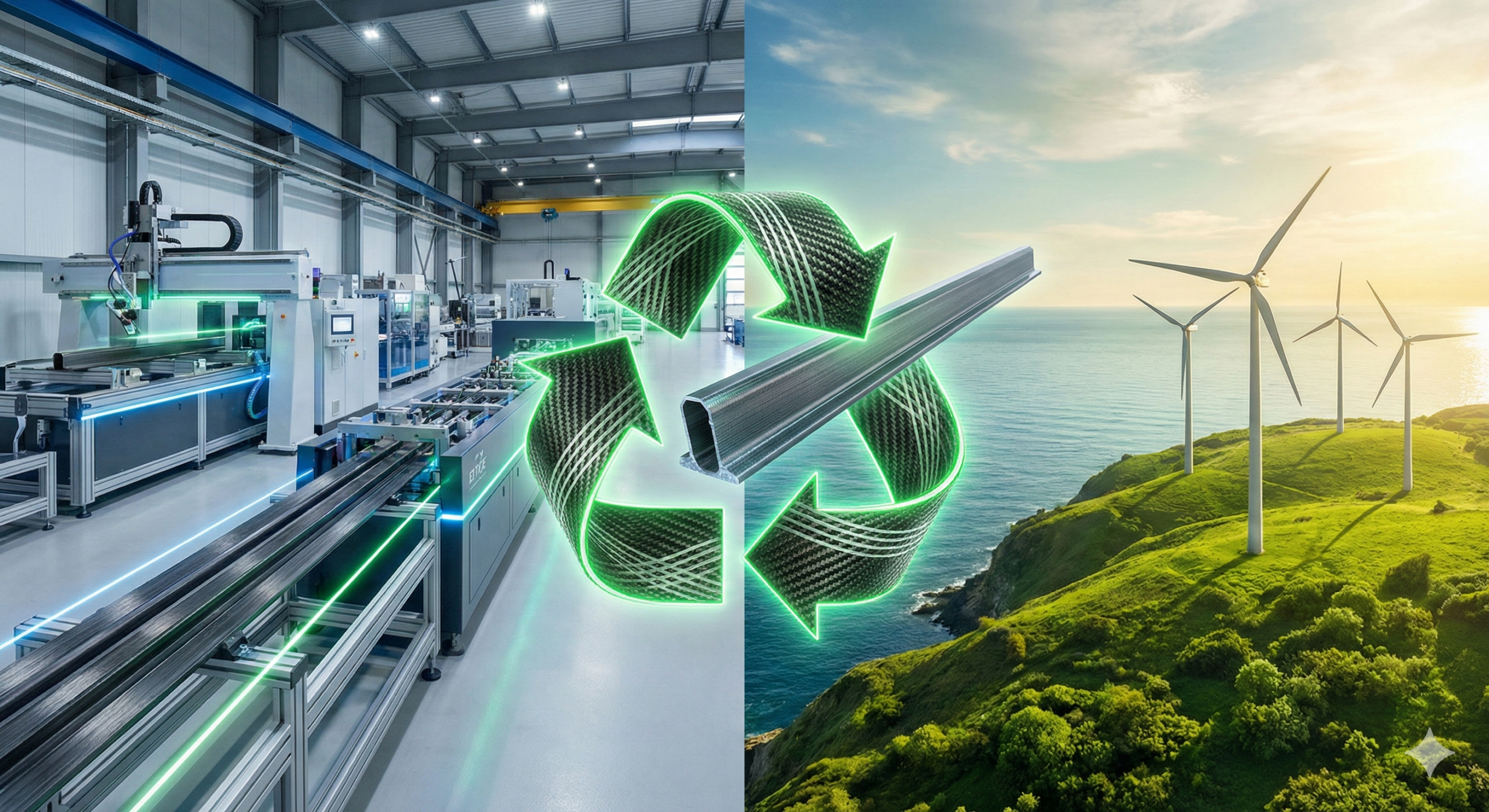
We’re living in a time when sustainability isn’t just a buzzword—it’s a business imperative. Industries around the world are grappling with a fundamental question: How do we maintain the high-performance materials that modern infrastructure demands while dramatically reducing our environmental footprint? The answer increasingly lies in recyclable composite materials and sustainable composite manufacturing processes.
Think about the challenge we face. Traditional materials have served industry well, but their environmental cost is undeniable. Steel production generates massive carbon emissions. Aluminum processing consumes enormous energy. And when these materials reach the end of their service life, they often end up in landfills or require energy-intensive recycling processes.
Composite materials have long been valued for their exceptional strength-to-weight ratio and durability. But historically, they’ve faced criticism for being difficult to recycle. That’s changing dramatically. Today’s sustainable composite materials combine outstanding performance with environmental responsibility, and the manufacturing processes that create them are becoming remarkably efficient.
At Super India Group, we’re witnessing this transformation firsthand. From innovation in recyclable resins to energy-efficient production methods and comprehensive lifecycle engineering, composites are increasingly aligned with global environmental goals. Let’s explore how sustainable manufacturing is reshaping the composites industry.
Why Sustainable Composite Manufacturing Matters More Than Ever
The business case for sustainable composite manufacturing extends far beyond regulatory compliance or public relations. It’s about fundamental operational efficiency, cost reduction, and future-proofing your business against increasingly stringent environmental regulations.
Consider the pressures facing manufacturers today. Governments worldwide are implementing carbon taxes, extended producer responsibility laws, and strict waste management requirements. Customers—both industrial buyers and end consumers—increasingly demand proof of environmental stewardship. Investors scrutinize environmental, social, and governance (ESG) metrics when making funding decisions. In this landscape, sustainable manufacturing isn’t optional; it’s essential for competitiveness.
The Four Pillars of Sustainable Composite Production
Dramatic Material Waste Reduction: Traditional manufacturing often generates substantial scrap—sometimes 30-40% of input materials become waste. Sustainable composite manufacturing techniques like pultrusion and filament winding achieve near-zero waste through precision material placement. Every gram of fiber and resin goes into the finished product, not the trash bin. This isn’t just environmentally responsible—it directly improves your bottom line by maximizing material utilization.
Significant Energy Consumption Reduction: Energy represents a major cost in manufacturing and a primary source of carbon emissions. Modern composite production methods use optimized curing cycles, low-energy resin systems, and heat recovery to dramatically reduce energy requirements compared to traditional material processing. Some facilities have achieved 40-50% energy reductions through process optimization and renewable energy integration.
Lower Carbon Emissions Throughout Production: Carbon emissions occur at multiple stages: raw material extraction, transportation, manufacturing, and end-of-life disposal. Sustainable composites address emissions holistically. Lighter weight reduces transportation emissions. Longer product lifespans mean fewer replacement cycles. And new recycling technologies enable material recovery rather than disposal, closing the loop on carbon impact.
Reduced Disposal Burden and Circular Economy Integration: The “take-make-dispose” model is ending. Recyclable composite materials enable circular economy thinking where products are designed from the outset for disassembly, recovery, and reuse. This reduces landfill burden, conserves virgin materials, and creates new revenue streams from material reclamation.
Companies embracing sustainable composite manufacturing aren’t just meeting environmental mandates—they’re gaining competitive advantages through operational efficiency, reduced material costs, and enhanced brand reputation.
Breakthrough Technologies in Recyclable Composite Materials
The challenge with traditional composites has always been their permanence. Once thermoset resins cure, they form irreversible chemical bonds. Heat them, and they char rather than melt. Grind them, and you get filler material at best. This permanence makes them durable in service but problematic at end-of-life.
That’s changing with revolutionary advances in recyclable composite materials. Let’s explore the technologies making this possible.
Four Revolutionary Approaches to Recyclability
Thermoplastic Composite Systems: Unlike traditional thermoset composites, thermoplastic composites can be reheated and reshaped multiple times without degrading their properties. Think of the difference between a hardboiled egg (thermoset) and chocolate (thermoplastic)—one change is permanent, the other reversible. Thermoplastic composites can be ground up, remelted, and reformed into new products, enabling true closed-loop recycling.
These systems are particularly valuable in automotive and consumer applications where design changes are frequent and end-of-life recycling infrastructure is established. Major manufacturers are increasingly specifying thermoplastic composites for components that previously used thermosets, driven by both environmental goals and the practical benefits of faster processing cycles.
Advanced Recyclable FRP Technologies: New recyclable FRP (Fiber Reinforced Polymer) technologies are emerging that maintain the excellent properties of traditional FRP while enabling end-of-life recovery. These include specially formulated resins that can be dissolved or broken down under specific conditions, allowing fiber recovery for reuse in new composites. At Super India Group, we’re seeing growing demand for these next-generation materials as industries seek to balance performance with environmental responsibility.
Reversible Resin Networks (Vitrimers): This represents one of the most exciting developments in composite chemistry. Reversible resin networks, also called vitrimers, behave like thermosets during service—they’re rigid, chemically resistant, and thermally stable. But when heated above a certain temperature, their chemical bonds become reversible, allowing the material to flow and be reshaped like a thermoplastic. This gives you the best of both worlds: thermoset performance with thermoplastic recyclability.
Sophisticated Resin Recovery Processes: Even for existing thermoset composites, new resin recovery technologies are making recycling viable. Chemical recycling processes can break down cured resins into their constituent monomers, which can then be purified and reused to make virgin-quality resin. Meanwhile, pyrolysis processes can recover fibers by burning off the resin in controlled oxygen-free environments, yielding fibers suitable for reuse in less demanding applications.
These technologies aren’t just laboratory curiosities—they’re entering commercial production. The composites industry is experiencing a fundamental shift toward materials that can be recovered and reused, driven by both environmental necessity and economic opportunity.
Precision Manufacturing: Where Zero Waste Meets High Performance
One of the most powerful aspects of sustainable composite manufacturing is that the same processes that maximize efficiency also minimize waste. Unlike traditional machining that removes material to create shape, composite manufacturing methods like pultrusion and filament winding add material only where it’s needed.
How Precision Processes Eliminate Waste
Controlled Fiber Placement for Optimal Strength: Advanced composite manufacturing methods allow engineers to place reinforcement fibers exactly where loads occur. This isn’t just efficient—it’s intelligent design. By putting material only where structural analysis indicates it’s needed, you achieve maximum strength with minimum weight and material consumption. Computer-controlled automated fiber placement systems can create complex load paths that would be impossible with traditional manufacturing.
Continuous Production with Minimal Scrap: Processes like pultrusion create continuous profiles by pulling fiber-reinforced resin through heated dies. This continuous process generates virtually no scrap during production—the only waste occurs when cutting profiles to length, and even this can often be used for shorter components or ground into filler. Compare this to metal extrusion or machining where significant material becomes chips or turnings.
Near-Zero Scrap Generation: Modern filament winding and tape laying processes achieve material utilization rates exceeding 95%. That means less than 5% of input materials become waste—a remarkable efficiency that translates directly to cost savings and environmental benefit. In high-volume production, this difference between 5% waste and 30% waste represents millions of dollars annually.
Optimized Material Usage Through Digital Design: Computer-aided design and finite element analysis allow engineers to optimize component designs before any material is used. This digital-first approach means products use precisely the amount of material required for their application—no more, no less. When combined with precision manufacturing processes, the result is exceptional material efficiency.
At Super India Group, our pultrusion facilities exemplify this precision approach. By carefully controlling fiber content, resin chemistry, and processing parameters, we achieve consistent quality with minimal waste—demonstrating that environmental responsibility and manufacturing excellence go hand in hand.
Energy-Efficient Production: Doing More with Less
Energy consumption in manufacturing affects both operational costs and environmental impact. The composite industry has made remarkable strides in developing energy-efficient composite production methods that reduce energy use without compromising quality or performance.
Four Strategies for Energy Reduction
Optimized Curing Cycles That Save Energy: Traditional composite curing often involved long heating cycles at elevated temperatures. Modern low-energy resin systems cure at lower temperatures or even at room temperature with appropriate catalysts. Some systems use UV light curing, which provides instant cure with minimal energy input. These advances dramatically reduce the energy required per part while often improving production speed.
Advanced Low-Energy Resin Formulations: Resin chemists have developed formulations that process at 60-80°C instead of the 120-180°C typical of older systems. This temperature reduction translates to 40-60% energy savings during cure. Some new sustainable resin systems even incorporate bio-based materials derived from renewable resources, reducing both energy and carbon footprint.
Intelligent Automated Controls: Modern composite manufacturing facilities use sophisticated automation and process control systems that optimize energy consumption in real-time. These systems monitor production continuously, adjusting heating, cooling, and processing parameters to minimize energy use while maintaining quality. Predictive algorithms can even anticipate production schedules and pre-condition equipment efficiently.
Heat Recovery and Reuse: Rather than venting waste heat to the atmosphere, progressive manufacturers capture and reuse it. Heat from curing ovens can preheat incoming materials or provide facility heating. Some facilities achieve 30-40% overall energy savings through comprehensive heat recovery systems. This isn’t complex technology—it’s smart system design that pays for itself through reduced energy costs.
The energy efficiency gains in sustainable composite manufacturing aren’t marginal improvements—they represent fundamental reimagining of how composites are produced. Facilities built with energy efficiency as a core design principle can operate at 50% or less of the energy consumption per part compared to older plants.
Long Lifecycle Performance: The Hidden Environmental Advantage
Here’s an often-overlooked aspect of sustainability: the longer a product lasts, the lower its environmental impact per year of service. Composite materials excel at longevity, and this durability represents perhaps their greatest environmental contribution.
Consider a typical infrastructure application—say, a cable tray system in a coastal telecommunications facility. A steel tray might last 10-15 years before corrosion necessitates replacement. That means multiple manufacturing cycles, multiple transportation events, multiple installations, and multiple disposal events over a 50-year planning horizon. A properly designed composite tray system might last the entire 50 years without replacement.
How Durability Reduces Environmental Impact
Superior Corrosion Resistance Extends Service Life: Composites don’t rust, corrode, or degrade in ways that affect structural integrity. In harsh environments—coastal areas, chemical plants, wastewater facilities—this corrosion resistance means composite components can outlast metal alternatives by decades. Each avoided replacement cycle prevents the environmental impact of manufacturing, transporting, and installing a new component.
Excellent Weather Stability Across Climates: From arctic cold to tropical heat, from arid deserts to humid rainforests, properly formulated composite materials maintain their properties across extreme temperature ranges and weather conditions. This climate adaptability means the same design can serve reliably worldwide, reducing the need for specialized regional variations.
Minimal Maintenance Requirements: Every maintenance activity has environmental impact—transportation to the site, replacement parts, disposal of worn components. Composite infrastructure typically requires minimal maintenance beyond basic inspection. No painting, no coating renewal, no rust treatment—just continued reliable service.
Reduced Lifecycle Emissions: When you calculate total lifecycle emissions—manufacturing, transportation, installation, maintenance, and disposal—long-lasting composite materials often show significantly lower impact than shorter-lived alternatives, even if the initial manufacturing energy is comparable. It’s not just about the material—it’s about how long it serves.
This durability advantage makes composite materials particularly attractive for infrastructure applications where long service life is valued and replacement is expensive or disruptive. Every year of extended service amplifies the environmental benefit.
Advanced Recycling Technologies: Closing the Loop
The future of composites is circular, not linear. While early composites were essentially permanent materials, today’s composite material recycling technologies are making it possible to recover and reuse both fibers and resins, creating truly sustainable material cycles.
Four Pathways to Composite Recycling
Mechanical Recycling for Secondary Applications: The simplest approach to composite recycling involves grinding composite waste into granules or powder. While this process breaks the continuous fibers into short segments, reducing mechanical properties, the resulting material remains valuable. Ground composites serve as reinforcing filler in concrete, as bulking agents in polymer compounds, or as raw material for compression-molded parts where ultra-high strength isn’t required.
Thermal Recovery Through Pyrolysis: Pyrolysis processes heat composite waste in oxygen-free environments, causing the resin to decompose and vaporize while leaving fibers intact. The resulting recovered fibers retain 80-90% of their original strength and can be reused in new composites, typically for less demanding applications than the original. The vaporized resin can be captured and used as fuel or chemical feedstock, recovering its energy value.
Chemical Recycling for High-Quality Recovery: The most sophisticated composite recycling technology uses solvents or chemical processes to break down cured resins into their original molecular building blocks. This approach can recover both clean fibers maintaining near-virgin properties and monomers that can be re-polymerized into virgin-quality resin. While currently more expensive than other methods, chemical recycling represents the holy grail of composite circularity.
Fiber Reclamation Through Advanced Processes: Emerging technologies like supercritical fluid treatment and specialized chemical baths can cleanly separate fibers from resin matrices with minimal damage. These fiber reclamation processes produce fibers that retain 90-95% of original properties—suitable for use in demanding structural applications. As these technologies scale up and costs decrease, they’ll enable true closed-loop recycling where end-of-life composites become feedstock for new high-performance products.
The recycling infrastructure for composites is still developing, but the trajectory is clear. Within the next decade, we expect composite recycling to become as routine as metal recycling is today, with established collection, processing, and remanufacturing channels creating genuine circular material flows.
Sustainable Applications Driving Composite Adoption
The demand for sustainable composite materials is accelerating across industries as companies recognize that environmental responsibility and high performance aren’t mutually exclusive. Let’s examine where these materials are making the greatest impact.
Key Industries Embracing Sustainable Composites
Telecommunications Infrastructure: As 5G networks expand and fiber optic deployment accelerates, telecom operators are increasingly specifying recyclable composite materials for cable reinforcement, structural components, and equipment enclosures. The combination of lightweight installation, corrosion resistance, and now recyclability aligns perfectly with sustainability goals while reducing total cost of ownership.
Renewable Energy Generation: Wind turbine blades represent one of the largest applications of composites globally. The industry is actively developing recyclable blade designs to address end-of-life challenges. New thermoplastic and chemically recyclable resins are being tested and deployed, ensuring that equipment generating clean energy is itself environmentally responsible throughout its lifecycle.
Transportation and Mobility: From automotive to rail to marine applications, transportation sectors are major consumers of sustainable composites. Lighter vehicles consume less fuel or electricity, directly reducing operational emissions. When these lightweight components are also recyclable, the environmental case becomes compelling. Electric vehicle manufacturers particularly favor recyclable composites as they work to minimize overall vehicle lifecycle impact.
Industrial Equipment and Infrastructure: Chemical plants, water treatment facilities, offshore platforms, and industrial buildings increasingly specify corrosion-resistant composites for their exceptional durability in harsh environments. The long service life inherent to composites aligns with sustainability goals by reducing replacement frequency and maintenance requirements.
At Super India Group, we’re seeing this sustainability-driven demand firsthand. Customers increasingly request not just technical data on strength and durability, but also lifecycle assessments, recyclability certifications, and carbon footprint documentation. The market is clearly moving toward sustainable composite solutions that deliver both performance and environmental responsibility.
The Future is Sustainable: Why This Transformation Matters
We’re witnessing a fundamental transformation in how composite materials are conceived, manufactured, and managed throughout their lifecycle. Sustainable composite manufacturing isn’t just becoming an industry standard—it’s becoming a competitive necessity.
The convergence of multiple trends is driving this change. Regulatory pressure is increasing globally, with carbon taxes, extended producer responsibility laws, and circular economy mandates reshaping business requirements. Customer demand for sustainable products is intensifying, particularly from major corporations with ambitious environmental targets. And perhaps most importantly, the technology is maturing—recyclable composite materials that once existed only in research labs are now entering commercial production.
The business case is becoming irrefutable. Energy-efficient production reduces operating costs. Precision manufacturing minimizes material waste and expense. Long product lifecycles reduce replacement costs. And emerging recycling technologies create new revenue streams from material recovery. Sustainability and profitability are increasingly aligned.
But beyond business metrics, there’s a larger responsibility. The materials we manufacture today will serve for decades, and the processes we use today will shape environmental impact for generations. By embracing sustainable composite manufacturing, we’re not just optimizing current operations—we’re building the foundation for a more sustainable industrial future.
At Super India Group, we’re committed to leading this transformation. From developing recyclable FRP products to implementing energy-efficient production processes and partnering with recycling technology providers, we’re investing in sustainable solutions that our customers and our planet need.
The path forward is clear. Recyclable composite materials enable high performance with dramatically lower environmental impact. Precision manufacturing processes minimize waste while maximizing efficiency. Energy-efficient production methods reduce both costs and carbon footprints. Long-lasting products distribute environmental impact across extended service lives. And emerging recycling technologies promise true circular material flows.
This isn’t just the future of composites—it’s the future of manufacturing. Industries that embrace sustainable composite manufacturing today will be the leaders tomorrow, meeting environmental mandates while delivering the high-performance materials that modern infrastructure demands.
The question is no longer whether to pursue sustainability, but how quickly you can transform your operations to align with this new reality. The technology exists. The business case is proven. The environmental necessity is undeniable. The time for sustainable composites is now.